Garlic (Allium sativum L )

Scientific classification
Kingdom: Plantae
(unranked): Angiosperms
(unranked): Monocots
Order: Asparagales
Family: Alliaceae
Subfamily: Allioideae
Tribe: Allieae
Genus: Allium
Species: A. sativum

Binomial name
Allium sativum
L.


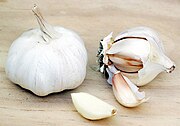
Allium sativum L., commonly known as garlic, is a species in the onion family Alliaceae. Its close relatives include the onion, shallot, leek, and chive. Garlic has been used throughout recorded history for both culinary and medicinal purposes. It has a characteristic pungent, spicy flavor that mellows and sweetens considerably with cooking.[1] A bulb of garlic, the most commonly used part of the plant, is divided into numerous fleshy sections called cloves. The cloves are used as seed, for consumption (raw or cooked), and for medicinal purposes. The leaves, stems (scape), and flowers (bulbils) on the head (spathe) are also edible and are most often consumed while immature and still tender. The papery, protective layers of "skin" over various parts of the plant and the roots attached to the bulb are the only parts not considered palatable.

Origin and distribution
Garlic output in 2005.The ancestry of cultivated garlic, according to Zohary and Hopf, is not definitely established: "A difficulty in the identification of its wild progenitor is the sterility of the cultivars."[2]

Allium sativum grows in the wild in areas where it has become naturalised; it probably descended from the species Allium longicuspis, which grows wild in southwestern Asia.[3] The "wild garlic," "crow garlic," and "field garlic" of Britain are the species Allium ursinum, Allium vineale, and Allium oleraceum, respectively. In North America, Allium vineale (known as "wild garlic" or "crow garlic") and Allium canadense, known as "meadow garlic" or "wild garlic" and "wild onion," are common weeds in fields.[4] One of the best-known "garlics," the so-called elephant garlic, is actually a wild leek (Allium ampeloprasum).

Side Effects
After eating a large quantity of garlic, a person will usually have halitosis. Their sweat and excreted oils will also smell like garlic. If an extremely large amount of garlic has been consumed, the person's mucus, vaginal discharge, dandruff, and even earwax will also smell like garlic.[citation needed] Washing the body with soap will not take away the scent, although perfumes will mask it. The smell usually fades over the course of several days.[citation needed]

Cultivation
Garlic growing in a container.Garlic is easy to grow and can be grown year-round in mild climates. In cold climates, cloves can be planted in the ground about six weeks before the soil freezes and harvested in late spring. Garlic plants are not attacked by pests. They can suffer from pink root, a disease that stunts the roots and turns them pink or red. Garlic plants can be grown close together, leaving enough room for the bulbs to mature, and are easily grown in containers of sufficient depth.

There are different types or subspecies of garlic, most notably hardneck garlic and softneck garlic. It is important to get the right kind of garlic for your latitude, as garlic can be day-length sensitive. Hardneck garlic is generally grown in cooler climates; softneck garlic is generally grown closer to the equator.[citation needed]

Production trends
Garlic is grown globally, but China is by far the largest producer of garlic, with approximately 10.5 billion kilograms (23 billion pounds) annually, accounting for over 77% of world output. India (4.1%) and South Korea (2%) follow, with Russia (1.6%) in fourth place and the United States (where garlic is grown primarily as a cash crop in every state except for Alaska) in fifth place (1.4%).[2] This leaves 16% of global garlic production in countries that produce less than 2% of global output. Much of the garlic production in the United States is centered on Gilroy, California, which calls itself the "garlic capital of the world." The town holds a garlic festival annually, which raises money for charity.[5]

Uses

Culinary uses
Garlic being crushed using a garlic press. Garlic bulbs and individual cloves, one peeled. Garlic scapes are often harvested early so that the bulbs will grow bigger.Garlic is widely used around the world for its pungent flavor as a seasoning or condiment. It is a fundamental component in many or most dishes of various regions, including eastern Asia, south Asia, Southeast Asia, the Middle East, northern Africa, southern Europe, and parts of South and Central America. The flavour varies in intensity and aroma with the different cooking methods. It is often paired with onion, tomato, or ginger. The parchmentlike skin is much like the skin of an onion and is typically removed before using in raw or cooked form. An alternative is to cut the top off the bulb, coat the cloves by dribbling olive oil (or other oil-based seasoning) over them, and roast them in the oven. The garlic softens and can be extracted from the cloves by squeezing the (root) end of the bulb, or individually by squeezing one end of the clove.

Oils are often flavored with garlic cloves. Commercially prepared oils are widely available, but when preparing garlic-infused oil at home, there is a risk of botulism if the product is not stored properly. To reduce this risk, the oil should be refrigerated and used within one week. Manufacturers add acids and/or other chemicals to eliminate the risk of botulism in their products.[6]

In some cuisine, the young bulbs are pickled for 3–6 weeks in a mixture of sugar, salt, and spices. In eastern Europe, the shoots are pickled and eaten as an appetizer.

Immature scapes are tender and edible. They are also known as "garlic spears," "stems," or "tops." Scapes generally have a milder taste than cloves. They are often used in stir frying or prepared like asparagus. Garlic leaves are a popular vegetable in many parts of Asia. The leaves are cut, cleaned, and then stir-fried with eggs, meat, or vegetables.

Mixing garlic with eggs and olive oil produces aioli. Garlic, oil, and a chunky base produce skordalia. Blending garlic, almond, oil, and soaked bread produces ajoblanco.
About 1/4 teaspoon of dried powdered garlic is equivalent to one fresh clove.

Storage
Domestically, garlic is stored warm (above 18°C [64°F]) and dry to keep it dormant (so that it does not sprout). It is traditionally hung; softneck varieties are often braided in strands, called "plaits" or grappes. Garlic is often kept in oil to produce flavoured oil; however, the practice requires measures to be taken to prevent the garlic from spoiling. Untreated garlic kept in oil at room temperature can support the growth of deadly Clostridium botulinum. Peeled cloves may be stored in wine or vinegar in the refrigerator.[7]
Commercially, garlic is stored at −3°C, also dry.[8][9]

Historical use
Garlic has been used as both food and medicine in many cultures for thousands of years, dating at least as far back as the time that the Giza pyramids were built. It formed part of the diet of the Israelites in Egypt (Numbers 11:5) and of the labourers employed by Khufu in constructing the pyramid. Garlic is still grown in Egypt, but the Syrian variety is the kind most esteemed now (see Rawlinson's Herodotus, 2.125).

It was consumed by ancient Greek and Roman soldiers, sailors, and rural classes (Virgil, Ecologues ii. 11), and, according to Pliny the Elder (Natural History xix. 32), by the African peasantry. Galen eulogizes it as the "rustic's theriac" (cure-all) (see F. Adams' Paulus Aegineta, p. 99), and Alexander Neckam, a writer of the 12th century (see Wright's edition of his works, p. 473, 1863), recommends it as a palliative for the heat of the sun in field labor.

In the account of Korea's establishment as a nation, gods were said to have given mortal women with bear and tiger temperaments an immortal's black garlic before mating with them. This is a genetically unique six-clove garlic that was to have given the women supernatural powers and immortality. This garlic is still cultivated in a few mountain areas today.

In his Natural History, Pliny gives an exceedingly long list of scenarios in which it was considered beneficial (N.H. xx. 23). Dr. T. Sydenham valued it as an application in confluent smallpox, and, says Cullen (Mat. Med. ii. p. 174, 1789), found some dropsies cured by it alone. Early in the 20th century, it was sometimes used in the treatment of pulmonary tuberculosis or phthisis.

Harvesting garlic, from Tacuinum sanitatis, 15th century (Bibliothèque nationale).Garlic was rare in traditional English cuisine (though it is said to have been grown in England before 1548) and has been a much more common ingredient in Mediterranean Europe. Garlic was placed by the ancient Greeks on the piles of stones at crossroads, as a supper for Hecate (Theophrastus, Characters, The Superstitious Man); and according to Pliny, garlic and onions were invoked as deities by the Egyptians at the taking of oaths. (Pliny also states that garlic demagnetizes lodestones, which is not factual.)[10] The inhabitants of Pelusium, in lower Egypt (who worshiped the onion), are said to have had an aversion to both onions and garlic as food.

To prevent the plant from running to leaf, Pliny (N.H. xix. 34) advised bending the stalk downward and covering with earth; seeding, he observes, may be prevented by twisting the stalk (by "seeding," he most likely meant the development of small, less potent bulbs).

Medicinal use and health benefits
Garlic, raw
Nutritional value per 100 g (3.5 oz)
Energy 150 kcal 620 kJ
Carbohydrates 33.06 g
- Sugars 1.00g
- Dietary fiber 2.1 g
Fat 0.5 g
Protein 6.39 g
- β-carotene 5 μg 0%
Thiamin (Vit. B1) 0.2 mg 15%
Riboflavin (Vit. B2) 0.11 mg 7%
Niacin (Vit. B3) 0.7 mg 5%
Pantothenic acid (B5) 0.596 mg 12%
Vitamin B6 1.235 mg 95%
Folate (Vit. B9) 3 μg 1%
Vitamin C 31.2 mg 52%
Calcium 181 mg 18%
Iron 1.7 mg 14%
Magnesium 25 mg 7%
Phosphorus 153 mg 22%
Potassium 401 mg 9%
Sodium 17 mg 1%
Zinc 1.16 mg 12%
Manganese 1.672 mg
Selenium 14.2 mcg

Percentages are relative to US
recommendations for adults.
Source: USDA Nutrient database
Garlic is claimed to help prevent heart disease (including atherosclerosis, high cholesterol, and high blood pressure) and cancer.[11] Animal studies, and some early investigational studies in humans, have suggested possible cardiovascular benefits of garlic. A Czech study found that garlic supplementation reduced accumulation of cholesterol on the vascular walls of animals.[12] Another study had similar results, with garlic supplementation significantly reducing aortic plaque deposits of cholesterol-fed rabbits.[13] Another study showed that supplementation with garlic extract inhibited vascular calcification in human patients with high blood cholesterol.[14] The known vasodilative effect of garlic is possibly caused by catabolism of garlic-derived polysulfides to hydrogen sulfide in red blood cells, a reaction that is dependent on reduced thiols in or on the RBC membrane. Hydrogen sulfide is an endogenous cardioprotective vascular cell-signaling molecule.[15]

However, a randomized clinical trial funded by the National Institutes of Health (NIH) in the United States and published in the Archives of Internal Medicine in 2007 found that the consumption of garlic in any form did not reduce blood cholesterol levels in patients with moderately high baseline cholesterol levels.[16][17]

“ Despite decades of research suggesting that garlic can improve cholesterol profiles, a new NIH-funded trial found absolutely no effects of raw garlic or garlic supplements on LDL, HDL, or triglycerides… The findings underscore the hazards of meta-analyses made up of small, flawed studies and the value of rigorously studying popular herbal remedies.

In 2007, the BBC reported that Allium sativum may have beneficial properties, such as preventing and fighting the common cold.[19] This assertion has the backing of long tradition in herbal medicine, which has used garlic for hoarseness and coughs.[20] The Cherokee also used it as an expectorant for coughs and croup.[21]

Allium sativum has been found to reduce platelet aggregation[22][23][24][25] and hyperlipidemia.[26][25][27]

Garlic is also alleged to help regulate blood sugar levels. Regular and prolonged use of therapeutic amounts of aged garlic extracts lower blood homocysteine levels and has shown to prevent some complications of diabetes mellitus.[28][29] People taking insulin should not consume medicinal amounts of garlic without consulting a physician.

In 1858, Louis Pasteur observed garlic's antibacterial activity, and it was used as an antiseptic to prevent gangrene during World War I and World War II.[30] More recently, it has been found from a clinical trial that a mouthwash containing 2.5% fresh garlic shows good antimicrobial activity, although the majority of the participants reported an unpleasant taste and halitosis.[31]

In modern naturopathy, garlic is used as a treatment for intestinal worms and other intestinal parasites, both orally and as an anal suppository. Garlic cloves are used as a remedy for infections (especially chest problems), digestive disorders, and fungal infections such as thrush.[3][4]

Garlic has been used reasonably successfully in AIDS patients to treat cryptosporidium in an uncontrolled study in China.[32] It has also been used by at least one AIDS patient to treat toxoplasmosis, another protozoal disease.[33]

Garlic supplementation in rats, along with a high protein diet, has been shown to boost testosterone levels.[34]

Properties
When crushed, Allium sativum yields allicin, a powerful antibiotic and antifungal compound (phytoncide). However, due to poor bioavailability, it is of limited use for oral consumption. It also contains alliin, ajoene, enzymes, vitamin B, minerals, and flavonoids.

The composition of the bulbs is approximately 84.09% water, 13.38% organic matter, and 1.53% inorganic matter, while the leaves are 87.14% water, 11.27% organic matter, and 1.59% inorganic matter.[citation needed]

The phytochemicals responsible for the sharp flavor of garlic are produced when the plant's cells are damaged. When a cell is broken by chopping, chewing, or crushing, enzymes stored in cell vacuoles trigger the breakdown of several sulfur-containing compounds stored in the cell fluids. The resultant compounds are responsible for the sharp or hot taste and strong smell of garlic. Some of the compounds are unstable and continue to evolve over time. Among the members of the onion family, garlic has by far the highest concentrations of initial reaction products, making garlic much more potent than onions, shallots, or leeks.[35] Although people have come to enjoy the taste of garlic, these compounds are believed to have evolved as a defensive mechanism, deterring animals like birds, insects, and worms from eating the plant. Humans, however, usually enjoy these sensations for some reason.[36]

A large number of sulfur compounds contribute to the smell and taste of garlic. Diallyl disulfide is believed to be an important odour component. Allicin has been found to be the compound most responsible for the "hot" sensation of raw garlic. This chemical opens thermoTRP (transient receptor potential) channels that are responsible for the burning sense of heat in foods. The process of cooking garlic removes allicin, thus mellowing its spiciness.[37]

When eaten in quantity, garlic may be strongly evident in the diner's sweat and breath the following day. This is because garlic's strong-smelling sulfur compounds are metabolized, forming allyl methyl sulfide. Allyl methyl sulfide (AMS) cannot be digested and is passed into the blood. It is carried to the lungs and the skin, where it is excreted. Since digestion takes several hours, and release of AMS several hours more, the effect of eating garlic may be present for a long time.

This well-known phenomenon of "garlic breath" is alleged to be alleviated by eating fresh parsley. The herb is, therefore, included in many garlic recipes, such as Pistou, Persillade, and the garlic butter spread used in garlic bread. However, since the odour results mainly from digestive processes placing compounds such as AMS in the blood, and AMS is then released through the lungs over the course of many hours, eating parsley provides only a temporary masking. One way of accelerating the release of AMS from the body is the use of a sauna. Due to its strong odor, garlic is sometimes called the "stinking rose."

Because of the AMS in the bloodstream, it is believed by some to act as a mosquito repellent. However, there is no evidence to suggest that garlic is actually effective for this purpose.[38]


Spiritual and religious perceptions
Garlic has been regarded as a force for both good and evil. A Christian myth considers that after Satan left the Garden of Eden, garlic arose in his left footprint and onion in the right.[39] In Europe, many cultures have used garlic for protection or white magic, perhaps owing to its reputation as a potent preventative medicine.[40] Central European folk beliefs considered garlic a powerful ward against demons, werewolves, and vampires.[40] To ward off vampires, garlic could be worn, hung in windows, or rubbed on chimneys and keyholes.[41]

In Taoism mythology, six-clove black garlic is used as part of the process of modifying a Taoist's genetics. It supposedly endows the users immortality by intensifying their vital energy or "chi."[citation needed]

The association of garlic to evil spirits may be based on the antibacterial, antiparasitic value of garlic, which could prevent infections that lead to delusions and other related mental illness symptoms.[42][43]

In both Hinduism and Jainism, garlic is considered to stimulate and warm the body and to increase one's desires. Hindus generally avoid using garlic and the related onion in the preparation of foods for religious festivities and events. Followers of the Jain religion avoid eating garlic and onion on a daily basis.

In connection with the odor associated with garlic, Islam views eating garlic and subsequently going to the mosque as inappropriate. "Whoever has eaten (garlic) should not approach our mosque," indicated Muhammad.[44]


Cautions
Known adverse effects of garlic include halitosis (nonbacterial bad breath), indigestion, nausea, emesis, and diarrhea.[45]
Garlic may interact with warfarin, antiplatelets, saquinavir, antihypertensives, calcium channel blockers, and hypoglycemic drugs, as well as other medications. Consult a health professional before taking a garlic supplement[45] or consuming excessive amounts of garlic.
Garlic can thin the blood, similar to the effect of aspirin.[46]
Two outbreaks of botulism have been caused by consuming commercially produced garlic-in-oil preparations that were not properly preserved. It is especially important for home preparation to use safe and tested food preservation methods to retard bacterial growth, such as including sufficient salt or acidity and keeping the mixture refrigerated. It is recommended to not keep home preparations for more than a week.[47][48]
While culinary quantities are considered safe for consumption, very high quantities of garlic and garlic supplements have been linked with an increased risk of bleeding, particularly during pregnancy and after surgery and childbirth.[49][45] Some breastfeeding mothers have found their babies slow to feed and have noted a garlic odour coming from their baby when they have consumed garlic.[50][45] The safety of garlic supplements had not been determined for children.[50]
The side effects of long-term garlic supplementation, if any exist, are largely unknown, and no FDA-approved study has been performed. However, garlic has been consumed for several thousand years without any adverse long-term effects, suggesting that modest quantities of garlic pose, at worst, minimal risks to normal individuals. Possible side effects include gastrointestinal discomfort, sweating, dizziness, allergic reactions, bleeding, and menstrual irregularities.[49]
Some degree of liver toxicity has been demonstrated in rats, particularly in extremely large quantities exceeding those that a rat would consume under normal situations.[51]
There have been several reports of serious burns resulting from garlic being applied topically for various purposes, including naturopathic uses and acne treatment, so care must be taken to test a small area of skin using a very low concentration of garlic.[52] On the basis of numerous reports of such burns, including burns to children, topical use of raw garlic, as well as insertion of raw garlic into body cavities, is discouraged. In particular, topical application of raw garlic to young children is not advisable.[53]
Garlic and onions might be toxic to cats or dogs.[54]

From Wikipedia

Buah Makasar

(Brucea javanica [L.] Merr.)
Sinonim :
B. amarissima, Desv., B. gracilis DC., B. sccnaatrana Roxb., Goraus amarissima Lour., Lus. sa arnarissirna O. Ktze., Rlzus javanica L.

Familia :
Simaroubaceae.

Uraian :
Buah makasar tumbuh liar di hutan, kadang-kadang ditanam sebagai tanaman pagar: Buah Makasar tumbuh pada ketinggian 1-500 m dpl. Perdu tegak, menahun, tinggi 1-2,5 m, berambut halus warna kuning. Daunnya berupa daun majemuk menyirip ganjil, jumlah anak daun 5-13, bertangkai, letak berhadapan. Helaian anak daun berbentuk lanset memanjang, ujung meruncing, pangkal berbentuk baji, tepi bergerigi kasar, permukaan atas berwarna hijau, permukaan bawah berwarna hijau muda, panjang 5-10 cm, lebar 2-4 cm. Bunga majemuk berkumpul dalam rangkaian berupa malai padat yang keluar dari ketiak daun, warna ungu kehijauan. Buahnya buah batu berbentuk bulat telur, panjang sekitar 8 mm, jika sudah masak berwarna hitam. Bijinya bulat, berwarna putih. Di Indonesia, buahnya disebut biji makasar. Buah makasar dapat diperbanyak dengan biji.

Nama Lokal :
NAMA DAERAH Sumatera: dadih-dadih, tambar sipago, t. sipogu, t. bui, malur, sikalur, belur. Jawa: kendung peucang, ki padesa, kuwalot, trawa!ot, walot (Sunda), kwalot (Jawa). Sulawesi: tambara marica (Makasar). Maluku: nagas (Ambon). NAMA ASING Ya dan zi (C), false sumac, java brucea fruit (I). NAMA SIMPLISIA Bruceae Fructus (buah makasar).

Penyakit Yang Dapat Diobati :
Rasanya pahit, sifatnya dingin, beracun (toksik), masuk meridian usus besar. Khasiat buah makasar dapat membersihkan panas dan racun, menghentikan perdarahan (hemostatis), membunuh parasit (parasiticic), antidisentri, dan antimalaria. Khasiat daun makasar dapat membersihkan panas dan racun. Buah makasar mengandung zat aktif, seperti asam oleat, bruceine, dan yatanoside A & B, yang berkhasiat antikanker pada Ehrlich ascitic cancer, sarcoma 37' sarcoma 180' cervix cancer 14' Walker carcinoma, 56, leucemia1,lo, dan leucemia3g8. Pada binatang, menghambat sintesa DNA sel kanker, meningkatkan daya fagositosis makrofag, serta membentuk sel darah dalam sumsum tulang. Penelitian daya antelmintik sari buah makasar terhadap cacing Ascaridia galli (cacing gelang ayam) secara in vitro dengan air rebusan 10% b/v ekstrak etanol dan fraksi sisa, menunjukkan hasil yang nyata. Artinya, sari buah makasar memiliki khasiat sebagai antelmintik. Pada takaran 20 ml air rebusan 10% b/v, 150 mg ekstrak etanol, dan 150 mg fraksi sisa, masing-masing dilarutkan dengan glukosa salin 5% menjadi 100 ml memberikan daya antelmintik yang tidak berbeda nyata dengan 32 mg piperasin sitrat yang dilarutkan dengan glukosa saline 5% menjadi 100 ml (Noverman, Jurusan Farmasi, FMIPA UNAND, 1990).

BAGIAN YANG DIGUNAKAN
Bagian yang digunakan adalah buah. Setelah buah dikumpulkan, bagian yang keras dibuang untuk diambil isinya. Selain buah, daun dan akar juga berkhasiat sebagai obat.

INDIKASI
Buah digunakan untuk pengobatan:
malaria,
disentri amuba, diare kronis akibat terinfeksi Trichomonas sp.,
keputihan,
wasir (hemoroid),
cacingan (nematoda, taemia),
papiloma di pangkal tenggorokan (laring), pita suara, liang telinga luar, dan gusi,
kanker pada kerongkongan (esofagus), lambung, rektum, paru-paru, leher rahim (serviks), dan kulit.

Akar digunakan untuk pengobatan:
malaria, dernam,
keracunan makanan.

Daun digunakan untuk mengatasi: sakit pinggang.

CARA PEMAKAIAN
Untuk obat yang diminum, giling 1,5-2 g isi buah makasar (kira-kira 10-15 biji) sampai halus, lalu masukkan ke dalam kapsul. Ramuan ini diminum setelah makan. Lakukan 2-3 kali sehari.
Pemakaian luar digunakan untuk menyembuhkan penyakit kutil (warts) dan mata ikan" (corns) di kaki. Pemakaian ramuan ini harus hati-hati supaya tidak mengenai kulit normal di sekitarnya. Daun buah makasar yang digiling halus dapat digunakan untuk mengompres bagian tubuh yang bengkak, akibat terbentur atau terpukul (memar) benda keras. Selain dapat menyembuhkan penyakit, ramuan ini dapat digunakan untuk mengusir belatung.

CONTOH PEMAKAIAN DI MASYARAKAT
Disentri amuba
Giling 10-15 buah makasar sampai halus, lalu masukkan ke dalam kapsul. Minum ramuan ini sekaligus setelah makan. Lakukan sehari 3 kali, selama 7-10 hari.

Disentri, air kemih dan tinja berdarah karena panas
Giling 25 buah makasar (maksimal 50 buah) sampai halus, lalu masukkan ke dalam kapsul. Minum ramuan ini sekaligus dengan larutan air gula batu.

Malaria
Ambil isi buah makasar, kira-kira 10 buah, lalu giling sampai halus. Masukkan ke dalam kapsul, lalu minum sekaligus. Lakukan 3 kali sehari selama 3 hari. Selanjutnya, dosis dikurangi setengahnya (5 buah) dan minum selama 5 hari.
Cuci 15-20 g akar buah makasar, lalu potong-potong seperlunya. Rebus dalam tiga gelas air bersih sampai tersisa satu gelas. Setelah dingin, saring dan air saringannya slap untuk diminum. Lakukan sehari dua kali, masing-masing 1/2 gelas.

Komposisi :
Buah makasar mengandung alkaloid (brucamarine, yatanine), glikosida (brucealin, yatanoside A dan B, kosamine), dan phenol (brucenol, bruceolic acid). Bijinya mengandung brusatol dan bruceine A, B, C, E, F, G, H. Daging buahnya mengandung minyak lemak, asam oleat, asam linoleat, asam stearat, dan asam palmitoleat. Buah dan daunnya mengandung tanin.

Temulawak

(Curcuma xanthorrhiza, Roxb.)
Sinonim :

Familia :
Zingiberanceae

Uraian :
Temulawak (curcuma xanthorrhiza) banyak ditemukan di hutan-hutan daerah tropis. Temulawak juga berkembang biak di tanah tegalan sekitar pemukiman, terutaama pada tanah gembur, sehingga buaah rimpangnya mudah berkembang menjadi besar. Temulawak termasuk jenis tumbuh-tumbuhan herba yang batang pohonnya berbentuk batang semu dan tingginya dapat mencapai 2 meter. Daunnya lebar dan pada setiap helaian dihubungkan dengan pelapah dan tangkai daun yang agak panjang. Temulawak mempunyai bunga yang berbentuk unik (bergerombol) dan berwarna kuning tua. Rimpang temulawak sejak lama dikenal sebagai bahan ramuan obat. Aroma dan warna khas dari rimpang temulawak adalah berbau tajam dan daging buahnya berwarna kekuning-kuningan. Daerah tumbuhnya selain di dataran rendaah juga dapat tumbuh baik sampai pada ketinggian tanah 1500 meter di atas permukaan laut.

Nama Lokal :
Temulawak, Temu putih (Indonesia), Temulawak (Jawa); Koneng Gede (Sunda), Temulabak (Madura);

Penyakit Yang Dapat Diobati :
Sakit limpa, Sakit ginjal, Sakit pinggang, Asma, Sakit kepala; Masuk angin, Maag, Sakit perut, Produksi ASI, Nafsu makan; Sembelit, Sakit cangkrang, Cacar air, Sariawan, Jerawat;

1. Sakit Limfa
Bahan: 2 rimpang temulawak, 1/2 rimpang lengkuas, 1 genggam
daun meniran.
Cara membuat: temulawak dan lengkuas diparut, kemudian semua
bahan tersebut direbus dengan 1 liter air sampai mendidih, dan
disaring.
Cara menggunakan: diminum 1 kali sehari 1 cangkir.

2. Sakit Ginjal
Bahan: 2 rimpang temulawak, 1 genggam daun kumis kucing, 1
genggam daun kacabeling.
Cara membuat : temulawak diiris tipis-tipis, kemudian direbus
bersama dengan bahan lainnya dengan 1 liter air, dan disaring.
Cara menggunakan: diminum selama 3 hari.

3. Sakit Pinggang
Bahan: 1 rimpang temulawak, 1 rimpang kunyit sebesar ibu jari, 1
genggam daun kumis kucing.
Cara membuat : semua bahan tersebut direbus dengan 1 liter air,
dan disaring.
Cara menggunakan: diminum 1 kali sehari 1 gelas.

4. Asma
Bahan: 1 1/2 rimpang temulawak, 1 potong gula aren.
Cara membuat: temulawak diiris tipis-tipis dan dikeringkan. Setelah
kering direbus dengan 5 gelas air ditambah 1 potong gula aren
sampai mendidih hingga tinggal 3 gelas, kemudian disaring.

5. Sakit Kepala dan masuk angin.
Bahan: beberapa rimpang temulawak.
Cara membuat: temulawak diiris tipis-tipis, dikeringkan dan ditumbuk
halus menjadi tepung. Kurang lebih 2 genggam tepung temulawak
direbus dengan 4-5 gelas air sampai mendidih hingga tinggal 3
gelas, kemudian disaring disaring.

6. Maag
Bahan: 1 rimpang temulawak.
Cara membuat: temulawak diiris tipis-tipis dan diangin-anginkan
sebentar, kemudian direbus dengan 5-7 gelas air sampai mendidih,
dan disaring.
Cara menggunakan: diminum 1 kali sehari 1 gelas.

7. Sakit perut, Sakit perut pada waktu haid
Bahan: 1 rimpang temulawak, 3 buah mata asam, 1 potong gula
kelapa, garam secukupnya.
Cara membuat: temulawak diparut, kemudian direbus bersama
bahan lainnya dengan 3-4 gelas air sampai mendidih hingga tinggal
2 gelas.
Cara menggunakan: diminum 2 kali sehari 1 cangkir, pagi dan sore.

8. Menghilangkan bau amis sewaktu haid :
Bahan: 1 rimpang temulawak, 5 buah mata asam, 1 potong gula
kelapa.
Cara membuat: temulawak diiris tipis-tipis dan diangin-anginkan,
kemudian bersama bahan lainnya ditaruh dalam waskom (rantang/
panci), diberi 2 gelas air panas dan ditutup rapat selama kurang lebih
15 menit, dan disaring.
Cara menggunakan : diminum 3 kali, 1 kali sehari.

9. Memperbanyak produksi ASI
Bahan: 1 1/2 rimpang temulawak, dan tepung saga secukupnya.
Cara membuat: temulawak diparut, kemudian kedua bahan tersebut
dicampur dan ditambah air panas secukupnya sehingga menjadi
bubur.
Cara menggunakan : dimakan biasa.

10. Memacu ASI yang macet
Bahan : 1 1/2 rimpang temulawak diparut, 1 potong gula kelapa,
2-3 sendok makan adonan sagu.
Cara membuat : temulawak diparut, kemudian bersama bahan
lainnya direbus dengan 1 liter air sampai mendidih dan disaring.
Cara menggunakan : diminum 2 kali sehari 1 cangkir secara teratur.

11. Kesulitan buang air besar/berak
Bahan: 1 rimpang temulawak, 3 buah mata asam, 1 potong gula
kelapa.
Cara membuat : temulawak diiris tipis-tipis dan diangin-anginkan
sampai kering, kemudian bersama bahan lainnya diseduh dengan air
panas secukupnya dan disaring.
Cara menggunakan: diminum biasa.

12. Sembelit
Bahan : 1 rimpang temulawak dan biji sawi secukupnya.
Cara membuat : kedua bahan tersebut ditumbuk sampai halus,
kemudian diseduh dengan air panas secukupnya dan disaring.
Cara menggunakan : diminum biasa.

13. Menambah nafsu makan
Bahan: 2 rimpang temulawak, 1/4 rimpang lengkuas, 1/2 genggam
daun meniran.
Cara membuat : semua bahan tersebut direbus dengan 3 gelas air
sampai mendidih hingga tinggal 2 gelas, kemudian disaring.
Cara menggunakan : diminum 2 kali sehari 1/2 gelas.

Komposisi :
KANDUNGAN KIMIA : Daging buah (rimpang) temulawak mempunyai beberapa kandungan senyawa kimia antara lain berupa fellandrean dan turmerol atau yang sering disebut minyak menguap. Kemudian minyak atsiri, kamfer, glukosida, foluymetik karbinol. Dan kurkumin yang terdapat pada rimpang tumbuhan ini bermanfaat sebagai acnevulgaris, disamping sebagai anti inflamasi (anti radang) dan anti hepototoksik (anti keracunan empedu).

Sumber Sentra Informasi Ipteknet

Tanaman Obat Temu lawak

Temu lawak
Klasifikasi ilmiah
Regnum: Plantae
Divisio: Magnoliophyta
Kelas: Liliopsida
Ordo: Zingiberales
Familia: Zingiberaceae
Subfamilia: Zingiberoideae
Tribe: Zingibereae
Genus: Curcuma
Spesies: Curcuma xanthorhiza

Nama binomial
Curcuma xanthorhiza
L.

Temu lawak (Curcuma xanthorhiza L.) adalah tanaman obat-obatan yang tergolong dalam suku temu-temuan (Zingiberaceae). Tanaman ini berasal dari Indonesia.

Tanaman temu lawak dapat tumbuh hingga setinggi 2 m, memiliki bunga berwarna kuning. Akar temu lawak sering digunakan sebagai bahan obat-obatan tradisional


Dari Wikipedia bahasa Indonesia, ensiklopedia bebas

Khasiat Delima Obat Alami

Buah yang berasal dari timur tengah ini berkhasiat mengobati berbagai macam penyakit. Seluruh bagian tanaman ini bisa digunakan sebagai obat, mulai buah, biji, bunga, daun, kulit buah, kulit kayu, hingga kulit akar.

Cacingan

a. Cuci 7 gram akar delima yang telah dikeringkan, lalu potong-potong seperlunya. Rebus dengan satu gelas air selama 15 menit. Setelah dingin, saring dan minum airnya sekaligus.

b. Rebus kulit delima kering dan serbuk biji pinang (masing-masing 15 gram) dengan tiga gelas air bersih. Didihkan perlahan-lahan selama satu jam. Setelah dingin, saring dan minum sekaligus sebelum makan pagi.

c. Campur jus buah delima dengan jus wortel, masing-masing setengah gelas. Aduk sampai merata, lalu minum sekaligus.

d. Masukkan satu sendok makan bubuk biji delima kering ke dalam segelas jus nanas yang belum terlalu masak. Aduk merata, minum sewaktu perut kosong.

Radang gusi
Cuci tjuh kuntum bunga delima dengan air bersih, lalu rebus dengan segelas air bersih sampai mendidih. Setelah dingin, saring dan gunakan untuk kumur-kumur.

Perdarahan
Rebus 20 gram bunga delima dengan tiga gelas air bersih sampai tersisa separuhnya. Minum air rebusan dua kali sehari, masing-masing tiga perempat gelas.

Luka
Campurkan serbuk kulit buah atau bunga delima secukupnya dengan minyak wijen. Aduk merata, lalu oleskan pada bagian yang luka.

Sariawan
Ambil dua buah delima segar yang sudah masak. Ambil isi berikut bijinya, lalu tumbuk sampai halus. Tambahkan satu gelas air sambil diaduk merata, lalu saring. Gunakan airnya untuk berkumur, lalu telan. Lakukan 2--3 kali sehari, sampai sembuh.

Sering kencing
Pilih satu buah delima segar yang telah masak, ambil isinya. Ambil segenggam kucai, lalu potong-potong seperlunya. Rebus kedua bahan itu dengan tiga gelas air bersih sampai tersisa separuhnya, angkat dan dinginkan. Minum air rebusan dua kali sehari, masing-masing tiga perempat gelas.

Keputihan
Rebus 30 gram kulit delima kering dan 15 gram herba sambiloto kering dengan satu liter air bersih. Biarkan sampai air rebusannya tersisa separuhnya. Setelah dingin, saring dan bagi untuk tiga kali minum, pagi, siang, dan malam hari. Air rebusan ini juga bisa digunakan untuk membasuh vagina.

Batuk
Ambil satu buah delima yang belum terlalu masak. Setiap malam sebelum tidur, kunyah biji delima tersebut, sesap airnya, kemudian buang bijinga.

Suara serak, tenggorokan kering
Ambil satu buah delima segar, belah, dan ambil isinya. Kunyah, lalu buang bijinya. Lakukan 2-3 kali sehari.

Gangguan pencernaan
50 gram daun delima segar dimasak dengan air. Minum sewaktu suam.

Menurunkan berat badan
Dua genggam daun delima muda diremas-remas dengan air matang, campurkan sedikit garam. Minum dua kali sehari.
(Ipteknet/dila)

Source : Suara Merdeka

Sehat dengan Delima

Oleh Prof Hembing Wijayakusuma

Delima sudah dikenal cukup luas di Indonesia. Tapi tanaman yang satu ini lebih banyak ditanam di pekarangan atau di taman sebagai tanaman hias, terutama karena buahnya yang merah mengkilap. Warna merah yang khas buah delima itu sering dipakai untuk melukiskan kecantikan seseorang gadis atau wanita dengan sebutan pipi atau bibirnya "merah delima". Kendati sebenarnya buah delima tidak hanya berwarna merah, tapi juga ada warna lain.

Di balik kecantikan buah delima tersebut, ternyata banyak sekali khasiatnya jika diramu dengan tanaman lain. Tapi sebelum ke situ, sebaiknya dikemukakan lebih dulu sosok tanaman delima ini.

Tumbuhan delima bercabang banyak tapi tidak rimbun, tingginya hanya sekitar 1,5 m. Daunnya bertangkai berbentuk bulat telur memanjang, mengkilat dan berukuran kecil. Bunga 1-5 kuntum, muncul di ujung percabangan dan di ketiak daun teratas, berwarna merah atau putih kekuningan, tapi ada juga berwarna ungu kehitaman. Buahnya berupa buah buni berbentuk bulat, warnanya merah mengkilap, kekuningan, putih, coklat kemerah-merahan atau ungu kehitaman, berbiji banyak, rasanya asam manis segar. Tumbuhan ini berbuah sepanjang tahun.

Delima berasal dari Persia dan sudah banyak dibudidayakan di Indonesia. Daerah yang baik untuk pertumbuhannya adalah daerah tropika yang musim kemaraunya panjang dan panas dengan ketinggian 1.000 m di atas permukaan laut. Akan tetapi dia juga banyak kita jumpai di dataran rendah seperti di Jakarta.

Delima mempunyai nama berbeda di beberapa daerah. Antara lain disebut delima oleh Melayu di Sumatera, glima (Aceh), glineu mekah (Gayo), dhalima (Madura), gangsalan (Jawa), dalima (Sunda), teliman (Sasak), lele kase dan rumu (Timor).

Berikut ini adalah khasiat delima untuk kesehatan, tentu saja dengan meramunya bersama tumbuhan lain yang juga berkhasiat obat.

Khasiat delima antara lain adalah: memperbaiki fungsi hormon wanita, meningkatkan fungsi hormon esterogen, sangat baik dikonsumsi wanita menjelang menopause atau sesudahnya, mengatasi frigiditas, keputihan, awet muda, mimisan, kencing manis, buang air besar mengandung darah, sering buang air kecil, radang tenggorokan, radang amandel, radang telinga, radang usus, radang paru-paru, serak, batuk darah, muntah darah, sinusitis, gangguan pencernaan, sariawan, sakit gigi, bau mulut, wasir, diare, sakit perut, kelebihan berat badan, cacingan dan lain-lain.

Cara pengolahan delima untuk mencegah dan mengatasi beberapa jenis gangguan kesehatan atau penyakit berikut.

Keputihan: 15 gr kulit delima kering dan 30 gr sambiloto segar atau 15 gr sambiloto kering, direbus dengan 600 cc air hingga tersisia 200 cc, saring dan airnya diminum. Muntah darah dan batuk mengandung darah: 30 gr bunga delima berikut 30 gr akar alang-alang direbus dengan 500 cc air hingga tersisa 200 cc, saring dan airnya diminum.

Sinusitis: 15 gr daun delima segar, 30 gr daun jagung segar dan 15 gr daun teh segar, direbus dengan air 500 cc hingga tersisa 200 cc, saring dan airnya diminum selagi hangat.

Frigiditas: 10 gr jinten dan 5 lembar daun sirih direbus dengan 200 cc air hingga tersisa 100 cc, setelah dingin airnya digunakan untuk membuat jus 1 buah buah delima, kemudian diminum.

Diare: 15 gr kulit delima kering berikut 10 gr daun teh direbus dengan 500 cc air hingga tersisia 200 cc, saring dan airnya diminum.

Cacingan: 15 gr kulit delima kering dan 5-10 gr biji pinang kering dijadikan bubuk. Ambil 5 gr bubuk tersebut lalu diseduh dengan 200 cc air panas, kemudian diminum hangat-hangat.

Sariawan: 1-2 buah delima segar, kemudian isinya ditumbuk sampa hancur. Setelah itu, hasil tumbukan tadi direndam dengan air beberapa saat. Gunakan air rendaman tersebut untuk berkumur-kumur.

Demikian beberapa resep yang murah meriah ini dan buktikan hasilnya setelah melakukannya secara teratur. Akan tetapi untuk penyakit yang berat atau serius disarankan untuk tetap konsultasi ke dokter.

[Prof HM Hembing Wijayakusuma, adalah ahli pengobatan tradisional dan akupunktur, Ketua Umum Perhimpunan Ahli Pengobat Tradisional & Akupunktur se-Indonesia (Hiptri)]

Sumber : Suara Karya

Tanaman Obat Delima

Delima
(Punica granatum L.)
Sinonim :Malum granatum Rumph.
Familia :Punicaceae.

Penyakit Yang Dapat Diobati :
Sewaktu panen, buah dikumpulkan. Bijinya dikeluarkan, lalu kulitnya dijemur sampai kering. Sebelum digunakan, dapat disimpan dalam wadah yang tertutup baik. Kulit buah rasanya asam, pahit, sifatnya hangat, astringen, beracun (toksik). Berkhasiat menghentikan perdarahan (hemostatis), peluruh cacing usus (vermifuga), antidiare, dan antivirus. Kulit buah dan bunganya merupakan astringen kuat. Rebusan keduanya bisa menghentikan perdarahan. Kulit kayu dan kulit akar mempunyai bau lemah dan rasa asam. Berkhasiat sebagai peluruh dahak, vermifuga, pencahar, dan astringen usus. Daunnya berkhasiat untuk peluruh haid. Daging buah (daging pembungkus biji) berkhasiat penyejuk, peluruh kentut. Biji sifatnya sejuk, tidak berracun, berkhasiat pereda demam, antitoksik, melumas paru, dan meredakan batuk. Kulit akar berkhasiat peluruh cacing usus. Kulit buah menghambat pertumbuhan basil typhoid. Kulit buah dapat mengendalikan penyebaran infeksi virus polio, virus herpes simpleks, clan virus HIV.

Uraian :
Delima berasal dari Timur Tengah, tersebar di daerah subtropik sampai tropik, dari dataran rendah sampai di bawah 1.000 m dpl. Tumbuhan ini menyukai tanah gembur yang tidak terendam air, dengan air tanah yang tidak dalam. Delima sering ditanam di kebun-kebun sebagai tanaman hias, tanaman obat, atau karena buahnya yang dapat dimakan. Berupa perdu atau pohon kecil dengan tinggi 2--5 m. Batang berkayu, ranting bersegi, percabangan banyak, lemah, berduri pada ketiak daunnya, cokelat ketika masih muda, dan hijau kotor setelah tua. Daun tunggal, bertangkai pendek, letaknya berkelompok. Helaian daun bentuknya lonjong sampai lanset, pangkal lancip, ujung tumpul, tepi rata, pertulangan menyirip, permukaan mengkilap, panjang 1--9 cm, lebar 0,5--2,5 cm, warnanya hijau. Bunga tunggal bertangkai pendek, keluar di ujung ranting atau di ketiak daun yang paling atas. Biasanya, terdapat satu sampai lima bunga, warnanya merah, putih, atau ungu. Berbunga sepanjang tahun. Buahnya buah buni, bentuknya bulat dengan diameter 5--12 cm, warna kulitnya beragam, seperti hijau keunguan, putih, cokelat kemerahan, atau ungu kehitaman. Kadang, terdapat bercak-bercak yang agak menonjol berwarna tebih tua. Bijinya banyak, kecil-kecil, bentuknya bulat panjang yang bersegi-segi agak pipih, keras, tersusun tidak beraturan, warnanya merah, merah jambu, atau putih. Dikenal tiga macam delima, yaitu delima putih, delima merah, dan delima ungu. Perbanyakan dengan setek, tunas akar atau cangkok.

Nama Lokal :
NAMA DAERAH Sumatera: glima (Aceh), glimeu mekah (Gayo), dalimo (Batak). Jawa: gangsalan (Jawa), dalima (Sunda), dhalima (Madura). Nusa Tenggara: jeliman (Sasak), talima (Bima), dila dae lok (Roti), lelo kase, rumau (Timor). Maluku: dilimene (Kisar). NAMA ASING Shi liu (C), granaatappel (B), grenadier (P), granatbaum (J), luru (V), thap thim (T), granada (Tag.), pomegranate (I). NAMA SIMPLISIA Granati Cortex (Wit kayu delima), Granati Pericarpium (Wit buah delima).

BAGIAN YANG DIGUNAKAN
Bagian tanaman yang digunakan sebagai obat adalah kulit kayu, kulit akar, kulit buah, daun, biji, dan bunganya. Kulit akar dikeringkan terlebih dahulu sebelum digunakan. Kulit buah dapat digunakan segar atau setelah dikeringkan.

INDIKASI
Kulit buah (shi flu pi) digunakan untuk:
sakit perut karena cacing,
buang air besar mengandung darah dan lendir (disentri amuba),
diare kronis,
perdarahan seperti wasir berdarah, muntah darah, batuk darah, perdarahan rahim, perdarahan rektum,
prolaps rektum,
radang tenggorok,
radang telinga,
keputihan (leukorea)
nyeri lambung.

Kulit akar dan kulit kayu digunakan untuk:
cacingan terutama cacing pita (taeniasis),
batuk,
diare.

Bunga digunakan untuk:
radang gusi,
perdarahan,
bronkhitis.

Daging buah digunakan untuk:
menurunkan berat badan,
cacingan,
sariawan, tenggorokan sakit, suara parau,
tekanan darah tinggi (hipertensi),
sering kencing,
rematik (artritis),
perut kembung

Biji digunakan untuk:
menurunkan demam, batuk,
keracunan
cacingan.

Cara Pemakaian
Untuk obat yang diminum, rebus kulit akar atau kulit kayu yang telah dikeringkan (7 g). Rebus kulit buah (10--15 g). Makan buahnya (1 buah) atau dibuat jus. Bisa dicampur dengan jus wortel.
Untuk pemakaian luar, rebus kulit buah atau kulit akar, lalu gunakan airnya setelah dingin untuk kumur-kumur (gargle) pada radang gusi, sakit tenggorok, luka tersiram air panas, infeksi jamur di kaki, atau disemprotkan ke liang kemaluan (vagina) pada keputihan. Gunakan jus buah delima untuk berkumur pada sariawan, radang gusi, gigi berlubang, atau sebagai obat kompres pada wasir yang sedang meradang.

PEMAKAIAN DI MASYARAKAT
Cacingan
Cuci akar delima yang telah dikeringkan (7 g.), lalu potong-potong seperlunya. Rebus dengan satu gelas air selama 15 menit. Setelah dingin, saring dan minum airnya sekaligus.
Rebus kulit delima kering dan serbuk biji pinang (masing-masing 15 g) dengan tiga gelas air bersih. Didihkan perlahan-lahan selama satu jam. Setelah dingin, saring dan minum sekaligus sebelum makan pagi.
Campur jus buah delima dengan jus wortel, masing-masing setengah gelas. Aduk sampai merata, lalu minum sekaligus
Masukkan bubuk biji delima kering (satu sendok makan) dalam segelas jus nanas yang belum terlalu masak. Aduk merata, minum sewaktu perut kosong.

Radang gusi
Cuci bunga delima (tujuh kuntum) dengan air bersih, lalu rebus dengan segelas air bersih sampai mendidih. Setelah dingin, saring dan gunakan untuk kumur-kumur.

Perdarahan
Rebus bunga delima (20 g) dengan tiga gelas air bersih sampai tersisa separuhnya. Minum air rebusan dua kali sehari, masing-masing tiga perempat gelas.

Luka
Campurkan serbuk kulit buah atau bunga delima secukupnya dengan minyak wijen. Aduk merata, lalu oleskan pada bagian yang luka.

Sariawan
Ambil dua buah delima segar yang sudah masak. Ambil isi berikut bijinya, lalu tumbuk sampai halus. Tambahkan satu gelas air sambil diaduk merata, lalu saring. Gunakan airnya untuk berkumur, lalu telan. Lakukan 2--3 kali sehari, sampai sembuh.

Sering kencing
Ambil isi buah delima (yang segar dan masak, satu buah) dan segenggam kucai, lalu potong-potong seperlunya. Rebus dengan tiga gelas air bersih sampai tersisa separuhnya, angkat dan dinginkan. Minum air rebusan dua kali sehari, masing-masing tiga perempat gelas.

Keputihan
Rebus kulit delima kering (30 g) dan herba sambiloto kering (15 g) dengan satu liter air bersih. Biarkan sampai air rebusannya tersisa separuhnya. Setelah dingin, saring clan bagi untuk tiga kali minum, pagi, siang, dan malam hari. Air rebusan ini juga bisa digunakan untuk cuci vagina. Khusus wanita yang sudah menikah, gunakan dengan alat semprot yang masuk ke liang vagina.

Batuk sudah berlangsung lama
Ambil sebuah delima yang belum terlalu masak. Setiap malam sebelum tidur, kunyah biji delima tersebut. Buang bijinya.

Suara serak, tenggorokan kering
Ambil sebuah delima segar, belah, dan ambil isinya. Kunyah, lalu buang bijinya. Lakukan 2--3 kali sehari.

Komposisi :
Kulit buah (shi liu pi) mengandung alkaloid pelletierene, granatin, betulic acid, ursolic acid, isoquercitrin, elligatanin, resin, triterpenoid, kalsium oksalat, dan pati. Kulit akar dan kulit kayu mengandung sekitar 20% elligatanin dan 0,5--1% senyawa alkaloid, antara lain alkaloid pelletierine (C8H14N0), pseudopelletierine (C9H15N0), metilpelletierine (C8H14NO.CH3), isopelletierine (C8H15N0), dan metilisopellettierine (C9H1,N0). Daun mengandung alkaloid, tanin, kalsium oksalat, lemak, sulfur, peroksidase. Jus buah mengandung asam sitrat, asam malat, glukosa, fruktosa, maltosa, vitamin (A, C), mineral (kalsium, fosfor, zat besi, magnesium, natrium, dan kalium), dan tanin. Alkaloid pelletierine sangat toksik dan menyebabkan kelumpuhan cacing pita, cacing gelang, dan cacing keremi. Kulit buah dan kulit kayu juga astringen kuat sehingga digunakan untuk pengobatan diare.

Sumber : Iptek.net

Delima (punica granatum)


Delima (punica granatum) adalah tanaman buah-buahan yang dapat tumbuh hingga 5-8 m. Tanaman ini diperkirakan berasal dari Iran, namun telah lama dikembangbiakkan di daerah Mediterania. Bangsa Moor memberi nama salah satu kota kuno di Spanyol, Granada, berdasarkan nama buah ini. Tanaman ini juga banyak ditanam di daerah Tiongkok Selatan dan Asia Tenggara.
From Wikipedia, the free encyclopedia

Pomegranate (punica granatum)

Scientific classification
Kingdom: Plantae
Division: Magnoliophyta
Class: Magnoliopsida
Subclass: Rosidae
Order: Myrtales
Family: Lythraceae
Genus: Punica
Species: P. granatum
Binomial name
Punica granatum
L.

The pomegranate (Punica granatum) is a fruit-bearing deciduous shrub or small tree growing to between five and eight metres tall. The pomegranate is native to the region from Iran to the Himalayas in northern India and has been cultivated and naturalized over the whole Mediterranean region and the Caucasus since ancient times. It is widely cultivated throughout Afghanistan, Algeria, Armenia, Azerbaijan, Iran, India, Pakistan, Syria, Turkey, the drier parts of southeast Asia, Peninsular Malaysia, the East Indies, and tropical Africa[1]. Introduced into Latin America and California by Spanish settlers in 1769, pomegranate is now cultivated in parts of California and Arizona for juice production.[2]

In the Northern Hemisphere, the fruit is typically in season from September to January.[3] In the Southern Hemisphere, it is in season from March to May.

Foliage and fruit
The leaves are opposite or sub-opposite, glossy, narrow oblong, entire, 3–7 cm long and 2 cm broad. The flowers are bright red, 3 cm in diameter, with four to five petals (often more on cultivated plants). The fruit is between a lemon and a grapefruit in size, 5–12 cm in diameter with a rounded hexagonal shape, and has thick reddish skin and around 600 seeds.[4] The seeds and surrounding pulp, ranging in color from white to deep red, called arils, are edible; indeed, the fruit of the pomegranate is a berry. There are some cultivars which have been introduced that have a range of pulp colors such as purple.

Punica granatum nana is a dwarf variety of P. granatum popularly used as Bonsai trees and as a patio plant. The only other species in the genus Punica is the Socotran pomegranate (Punica protopunica), which is endemic to the island of Socotra. It differs in having pink (not red) flowers and smaller, less sweet fruit. Pomegranates are drought tolerant, and can be grown in dry areas with either a Mediterranean winter rainfall climate or in summer rainfall climates. In wetter areas, they are prone to root decay from fungal diseases. They are tolerant of moderate frost, down to about −10°C (14°F).

Etymology
The name "pomegranate" derives from Latin pomum ("apple") and granatus ("seeded"). This has influenced the common name for pomegranate in many languages (e.g., German Granatapfel, seeded apple). The genus name Punica is named for the Phoenicians, who were active in broadening its cultivation, partly for religious reasons. In classical Latin, where "malum" was broadly applied to many apple-like fruits, the pomegranate's name was malum punicum or malum granatum, the latter giving rise to the Italian name melograno, or less commonly melagrana.

A widespread root for "pomegranate" comes from the Ancient Egyptian rmn, from which derive the Hebrew rimmôn, and Arabic rummân. This root was given by Arabs to other languages, including Portuguese (romã)[5], Kabyle rrumman and Maltese "rummien". The pomegranate ('rimmôn') is mentioned in the Bible as one of the seven fruits/plants that Israel was blessed with, and in Hebrew, 'rimmôn' is also the name of the weapon now called the grenade. According to Webster's New Spanish-English Dictionary, "granada," the Spanish word for "pomegranate," could also mean "grenade." According to the OED, the word "grenade" originated about 1532 from the French name for the pomegranate, la grenade. La grenade also gives us the word grenadine, the name of a kind of fruit syrup, originally made from pomegranates, which is widely used as a cordial and in cocktails.

Origin, cultivation and uses
The pomegranate originated in Persia and has been cultivated in Georgia, Armenia and the Mediterranean region for several millennia.[6]

In Georgia, and Armenia to the east of the Black Sea, there are wild pomegranate groves outside of ancient abandoned settlements. The cultivation of the pomegranate has a long history in Armenia, where decayed remains of pomegranates dating back to 1000 BC have been found. [7]

Carbonized exocarp of the fruit has been identified in Early Bronze Age levels of Jericho, as well as Late Bronze Age levels of Hala Sultan Tekke on Cyprus and Tiryns[citation needed]. A large, dry pomegranate was found in the tomb of Djehuty, the butler of Queen Hatshepsut; Mesopotamian cuneiform records mention pomegranates from the mid-Third millennium BC onwards.[8] It is also extensively grown in South China and in Southeast Asia, whether originally spread along the route of the Silk Road or brought by sea traders.

The ancient city of Granada in Spain was renamed after the fruit during the Moorish period. Spanish colonists later introduced the fruit to the Caribbean and Latin America, but in the English colonies it was less at home: "Don't use the pomegranate inhospitably, a stranger that has come so far to pay his respects to thee," the English Quaker Peter Collinson wrote to the botanizing John Bartram in Philadelphia, 1762. "Plant it against the side of thy house, nail it close to the wall. In this manner it thrives wonderfully with us, and flowers beautifully, and bears fruit this hot year. I have twenty-four on one tree... Doctor Fothergill says, of all trees this is most salutiferous to mankind."[9] The pomegranate had been introduced as an exotic to England the previous century, by John Tradescant the elder, but the disappointment that it did not set fruit there led to its repeated introduction to the American colonies, even New England. It succeeded in the South: Bartram received a barrel of pomegranates and oranges from a correspondent in Charleston, South Carolina, 1764. Thomas Jefferson planted pomegranates at Monticello in 1771: he had them from George Wythe of Williamsburg.[10]

From Wikipedia, the free encyclopedia


Labels: Delima, Pomegranate, Punica granatum

Jarak

(Ricinus communis Linn.)
Sinonim :
R. inermis et lividus, Jacq. R. speciosus, Burm. R. viridis, Willd. Croton spinosa, Linn.

Familia :
Euphorbiaceae

Penyakit Yang Dapat Diobati :
Kanker rahim, Kank. kulit, Sulit buang air besar, Sulit. Melahirkan, ; TBC, Bisul, Koreng, Scabies, Infeksi jamur, Jerawat, lumpuh otot muka; Gatal, Batuk, Hernia, Bengkak, Reumatik, Tetanus, Bronkhitis;

Uraian :
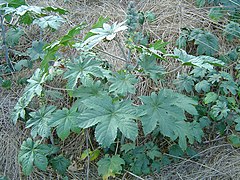
Tumbuh liar di hutan, tanah kosong, sepanjang pantai, atau ditanam sebagai komoditi perkebunan. Dapat tumbuh di areal yang kurang subur asalkan pH tanahnya 6 - 7 dan drainase airnya baik, sebab akar jarak tidak tahan terhadap genangan air. jarak merupakan perdu tegak yang tumbuh pada ketinggian antara 0 - 800 m di atas permukaan laut, tinggi 2 - 3 m, mudah dikembang-biakkan dengan biji-bijian yang telah tua. Jarak adalah tumbuhan setahun (anual) dengan batang bulat licin, berongga, berbuku-buku jelas dengan tanda bekas tangkai daun yang lepas, warna hijau bersemburat merah tengguli. Daun tunggal, tumbuh berseling, bangun daun bulat dengan diameter 10 - 40 cm, bercangap menjari 7 - 9, ujung daun runcing, tepi bergigi, warna daun di permukaan atas hijau tua permukaan bawah hijau muda (Ada varietas yang berwarna merah). Tangkai daun panjang, berwarna merah tengguli, daun bertulang menjari. Bunga majemuk, berwarna kuning oranye, berkelamin satu. Buahnya bulat berkumpul dalam tandan, berupa buah kendaga, dengan 3 ruangan, setiap ruang berisi satu biji. Buahnya mempunyai duri-duri yang lunak, berwarna hijau muda dengan rambut merah.

Nama Lokal :
Jarak, jarak jitun, kaliki (Sunda), Jarak (jawa), Kaleke (Madura),; Gloah, lulang, dulang, jarak, kalikih alang, jarag (Sumatra),; Malasai, kalalei, alale, tangang jara, peleng kaliki jera (Sulawesi); Jarak (Bali), luluk (Roti), paku penuai (Timor), Balacai (Ternate), ; Balacai tamekot (Halmahera), tetanga (Bima), luluk (Roti),; Bi ma (China).;

BAGIAN YANG DIPAKAI:
Biji, akar, daun dan minyak dari bijinya.

KEGUNAAN:
Biji: Kesulitan buang air besar (Constipation), kanker mulut rahim dan
kulit (Carsinoma of cervix and skin), visceroptosis/ gastroptosis,
kesulitan melahirkan dan retensi placenta/ari-ari (difficult labor and
retention of placenta), kelumpuhan otot muka (facial nerve
paralysis), TBC kelenjar, bisul, koreng, scabies dan infeksi jamur.
Juga dipakai pada bengkak (edema).

Daun: Koreng, eczema, gatal (pruritus), batuk sesak, hernia.

akar: Rheumatik sendi, tetanus, epilepsi, bronchitis pada anak-anak,
luka terpukul, TBC kelenjar, schizophrenia (gangguan jiwa).

Minyak : Constipasi, koreng, luka bakar.

CARA PEMAKAIAN:
Biji :
1. Koreng:
20 biji dibuang kulitnya, dilumatkan menjadi berbentuk bubur,
ditambah sedikit garam dan diaduk rata. Tempel di tempat sakit
sehari 2x.

2. Prolapsus uterus dan rectum:
Lumatkan biji jarak dan dipakai/ditempelkan pada titik Pai hui yang
terletak di kepala.

3. Kesulitan melahirkan dan retensi placenta:
Lumatkan biji jarak dan tempelkan ketitik akupunktur Yungchuan
(VIII/1 = K-1) yang terletak di tengah-tengah telapak kaki.

4. Kelumpuhan otot wajah:
Lumatkan biji jarak, tempelkan pada sendi mandibular dan
lengkungan mulut, 1 x hari, selama 10 hari.

5. Kanker cervix:
Salep/cream berisi 3-50/o ricin & 3% dimethyl sulfoxide, dioleskan
pada kanker cervix 1 x / hari, 5 - 6x / minggu untuk 1 - 2 bulan.
Dilakukan bersama-sama dengan penyinaran extracorporal.

Efek samping:
nyeri perut, gatal pada liang kemaluan, gatal seluruh tubuh, eczema, biduran (Urticaria), serak, pembengkakan larynx, gatal pada tenggorokan, pengelupasan kulit telapak tangan dan kaki, menggigil, demam, yang hilang dengan obat-obat symptomatik.

Daun: Pemakaian luar: Direbus, airnya untuk cuci atau dilumatkan,
tempel.
- Bengkak: Daun dikukus matang, dibungkus ditempat yang sakit.
- Hernia: Daun + sedikit garam dilumatkan, tempelkan dititik
tengah telapak kaki.
- Koreng: Daun segar direndam air panas sampai lemas,
tempelkan ke tempat sakit.

Minyak:
- Constipasi: Anak-anak 4 ml dan Dewasa 5 - 20 ml, minum pagi
hari sewaktu perut kosong. Wanita hamil dan sedang haid
dilarang minum (Sebabkan kongesti ringan pada organ panggul).

Akar: 15 - 30 gr, rebus atau ditim, minum.
Pemakaian luar: Dilumatkan, tempel.
- Rheumatik persendian, epilepsi (Ayan): 15 - 30 gr akar direbus,
minum.
- Pegal-pegal, luka terpukul: 9 - 12 gr akar kering, rebus.

GEJALA KERACUNAN:
Sakit kepala, muntah berak, panas, leukositosis, gambaran darah putih bergeser kekiri, produksi kencing terhenti, keringat dingin, kejang-kejang, prostration, meninggal. Kematian dapat terjadi dengan menelan 20 biji jarak pada orang dewasa dan 2 - 7 biji pada anak-anak.
Menghilangkan racunnya dilakukan dengan cara memanaskan 100' C atau lebih selama 20 menit atau direbus selama 2 jam. Tetapi khasiat anti kanker hilang dengan pemanasan.

Komposisi :
SIFAT KIMIAWI DAN EFEK FARMAKOLOGIS: Biji : Rasa manis, pedas, netral. Biji segar sangat beracun, yang hilang dengan cara direbus selama 2 jam atau dengan pemanasan 100'C selama 20 menit. Anti radang, pencahar (purgative actions), koreksi prolaps, anti-neoplastik (anti-kanker), menghilangkan racun (eliminates toxin). Akar: Bersifat penenang, anti-rheumatik. KANDUNGAN KIMIA: Biji : Minyak ricinic 40- 50 % dengan kandungan glyceride dari ricinoleic acid, isoricinoleic acid, oleic acid, linolenic acid, dan stearic acid. Juga mengandung ricinine, sejumlah kecil cytochrome C, Lipase dan beberapa enzym. Disamping ricin D, dengan cara pemurnian bertingkat didapat acidic ricin dan basic ricin. Daun: Kaemferol-3-rutinoside, nicotiflorin, isoquercitrin, rutin, kaempferol, quercetin, astragalin, reynoutrin, ricinine, vit.C 275 mg %. Minyak: Ricinoleic acid 80%, palmitic acid, stearic acid, linoleic acid, linolenic acid, dihydroxystearic acid, triricinolein 68,2%, diricinolein 28%, monoricinolein 2,9%, nonricinolein 0,9%. Akar: Methyltrans-2-decene-4,6,8-triynoate, 1-tridecene-3,5,7,9,11-pentyne, Beta-sitosterol.

Sumber Sentra informasi IPTEK

Jarak pohon

Klasifikasi ilmiah
Regnum: Plantae
Divisio: Magnoliophyta
Kelas: Magnoliopsida
Ordo: Malpighiales
Familia: Euphorbiaceae
Subfamilia: Acalyphoideae
Tribe: Acalypheae
Subtribe: Ricininae
Genus: Ricinus
Spesies: R. communis
Nama binomial
Ricinus communis
L.


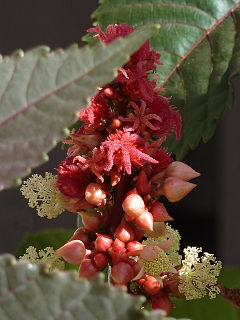
Jarak (Ricinus communis) adalah spesies tanaman dari Euphorbiaceae dan tergolong ke dalam genus Ricinus, subtribe Ricininae. Tanaman ini merupakan sumber minyak jarak, dan mengandung zat ricin, sejenis racun.

Tanaman jarak dapat tumbuh liar di hutan, tanah kosong, di daerah pantai, tapi sering juga dikembangbiakkan dalam perkebunan. Tanaman ini tergolong tanaman perdu, memiliki daun tunggal menjari antara 7 - 9, berdiameter 10-40 cm.

Jarak pohon merupakan satu-satunya tumbuhan yang bijinya kaya akan suatu asam lemak hidroksi, yaitu asam ricinoleat. Kehadiran asam lemak ini membuat minyak biji jarak memiliki kekentalan yang stabil pada suhu tinggi sehingga minyak jarak dipakai sebagai campuran pelumas.

Castor oil plant (Ricinus communis,)

The castor oil plant, Ricinus communis, is a plant species of the Euphorbiaceae (the evolution of this plant family is relatively unexplored [1]) the sole member of the genus Ricinus and of the subtribe Ricininae. Its seed is the castor bean which, despite its name, is not a true bean.

Castor seed is the source of castor oil, which has a wide variety of uses. The seeds contain between 40% and 60% oil that is rich in triglycerides, mainly ricinolein. The seed coat contains ricin, a poison, which is also present in lower concentrations throughout the plant.

The toxicity of raw castor beans is well-known, and reports of actual poisoning are relatively rare, even though as few as one bean can kill any human and four could kill a horse.[1][2]

Castor seeds have been found in Egyptian tombs dating back to 4000 BC being used mostly to fuel lamps because of the slow burning oil. Herodotus and other Greek travelers have noted the use of castor seed oil for lighting, body ointments, and improving hair growth and texture. Cleopatra is reputed to have used it to brighten the whites of her eyes. The Ebers Papyrus is an ancient Egyptian medical treatise believed to date from 1552 BC. Translated in 1872, it describes castor oil as a purgative.

Global castor seed production is around 1 million tons per year. Leading producing areas are India (with over 60% of the global yield), China and Brazil. There are several active breeding programmes.

Another plant species, Fatsia Japonica, looks similar to the castor oil plant and is known as the false castor oil plant.

Description
Castor oil plant can reach a height of 2–3 m in a year (if sown early, under glass, and kept at a temperature of around 20°Celsius/68°Fahreheit until planted out [2]).

The glossy leaves are 15–45 cm long, long-stalked, alternate and palmate with 5–12 deep lobes with coarsely toothed segments. Their colour varies from dark green, sometimes with a reddish tinge, to dark reddish purple or bronze.

The stems and the spherical, spiny seed pods also vary in pigmentation. The pods are more showy than the flowers (the male flowers are yellowish-green with prominent creamy stamens and are carried in ovoid spikes up to 15 cm long; the female flowers, borne at the tips of the spikes, have prominent red stigmas). [3]

Terminating stems are panicle-like inflorescences of green monoecious flowers, the stalked female flowers above the male flowers below, both without petals.

The fruit is a spiny, greenish capsule with large, oval, shiny, bean-like, highly poisonous seeds with variable brownish motling.

Nomenclature
The name Ricinus is a Latin word for tick; the seed is so named because it has markings and a bump at the end which resemble certain ticks. The common name "castor oil" likely comes from its use as a replacement for castoreum, a perfume base made from the dried perineal glands of the beaver (castor in Latin). It has another common name, Palm of Christ, or Palma Christi, that derives from castor oil's ability to heal wounds and cure ailments.
Habitat and growth
Although castor is indigenous to the southeastern Mediterranean region, Eastern Africa, and India, today it is widespread throughout tropical regions. [4] Castor establishes itself easily as an apparently "native" plant and can often be found on wasteland. It is widely grown as a crop in Ethiopia. It is also used extensively as a decorative plant in parks and other public areas, particularly as a "dot plant" in traditional bedding schemes. Of the red and white variety, the red is seen as an ornamental plant, the white is used medicinally.
Castor oil seed output in 2006

Although monotypic, the castor oil plant can vary greatly in its growth habit and appearance.

It is a fast-growing, suckering perennial shrub which can reach the size of a small tree (around 12 m), but it is not hardy. However it grows well outside, at least in Southern England, and the leaves do not appear to suffer frost damage in sheltered spots, where it remains evergreen. In areas prone to frost it is usually shorter and grown as if it were an annual.

Selections have been made by breeders for use as ornamental plants: 'Gibsonii' has red-tinged leaves with reddish veins and pinkish-green seed pods; 'Carmencita Pink' is similar, with pinkish-red stems; 'Carmencita Bright Red' has red stems, dark purplish leaves and red seed pods; all grow to around 1.5 m tall as annuals. [5] 'Impala' is compact (only 1.2 m tall) with reddish foliage and stems, brightest on the young shoots; 'Red Spire' is tall (2–3 m) with red stems and bronze foliage; 'Zanzibarensis' is also tall (2–3 m), with large, mid-green leaves (50 cm long) with white midribs. (Heights refer to plants grown as annuals.) [6]

Plant-animal interactions
Ricinus communis is the host plant of the Common Castor butterfly (Ariadne merione) and the Castor Semi-Looper moth (Achaea janata). It is also used as a food plant by the larvae of some other species of Lepidoptera, including Hypercompe hambletoni and the Nutmeg (Discestra trifolii).

Among birds, it is a favourite food of the Tambourine Dove (Turtur tympanistria).

Castor beans are very toxic.

Uses

Main article: Castor oil

Usage in ethnobotany The use of castor seed oil in India has been documented since 2000 BC for use in lamps and in local medicine as a laxative, purgative, and cathartic in Unani, Ayurvedic and other ethnomedical systems. Traditional Ayurvedic medicine considers castor oil the king of medicinals for curing arthritic diseases.

Castor seed and its oil have also been used in China for centuries, mainly prescribed in local medicine for internal use or use in dressings.

The oil has undecylenic acid, a powerful chemical for dermal fungus.

The oil is known to have been used as an instrument of coercion by the Fascist militia (Camicie Nere) under the regime of Italian dictator Benito Mussolini. Dissidents and regime opponents were forced to ingest the oil in large amounts, triggering severe diarrhoea and dehydration, which could ultimately cause death. This punishment method was originally thought of by Gabriele D'Annunzio, the Italian poet and Fascist supporter, during the First World War.

It was used in rituals of sacrifice to please the gods in early civilizations.

In Brazil, castor plants are abundant. The "fruits" are used by children as slingshot balls. Mamonas, as the fruits are called, serve perfectly as projectiles for slingshots since they have the right weight, size and hardness. Mamona oil is now being used to produce biodiesel in poor rural areas of the country.

Production
India is world leader in Castor Beans production followed by China and then Brazil.

From Wikipedia, the free encyclopedia
(Redirected from Ricinus communis)

Lidah Buaya (Aloe Vera Linn.)

(Aloe Vera Linn.)
Sinonim :
Aloe barbadensis, Mill. Aloe vulgaris, Lamk.

Familia :
Liliaceae

Penyakit Yang Dapat Diobati :
Shampo, minuman, Obat cacing, Luka bakar, Bisul, Luka bernanah; Amandel, Sakit mata, Keseleo, Kosmetik, Jerawat;

Uraian :
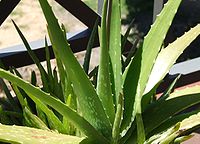
Tumbuhan obat ini Tumbuh liar di tempat yang berhawa panas atau ditanam orang di pot dan pekarangan rumah sebagai tanaman hias. Daunnya agak runcing berbentuk taji, tebal, getas, tepinya bergerigi/ berduri kecil, permukaan berbintik-bintik, panjang 15-36 cm, lebar 2-6 cm, bunga bertangkai yang panjangnya 60-90 cm, bunga berwarna kuning kemerahan (jingga), Banyak di Afrika bagian Utara, Hindia Barat. a. Batang Tanaman Aloe Vera berbatang pendek. Batangnya tidak kelihatan karena tertutup oleh daun-daun yang rapat dan sebagian terbenam dalam tanah. Melalui batang ini akan muncul tunas-tunas yang selanjutnya menjadikan anakan. Aloe Vera yang bertangkai panjang juga muncul dari batang melalui celah-celah atau ketiak daun. Batang Aloe Vera juga dapat disetek untuk perbanyakan tanaman. Peremajaan tanaman ini dilakukan dengan memangkas habis daun dan batangnya, kemudian dari sisa tunggul batang ini akan muncul tunas-tunas baru atau anakan. b. Daun Daun tanaman Aloe Vera berbentuk pita dengan helaian yang memanjang. Daunnya berdaging tebal, tidak bertulang, berwarna hijau keabu-abuan, bersifaat sukulen (banyak mengandung air) dan banyak mengandung getah atau lendir (gel) sebagai bahan baku obat. Tanaman lidah buaya tahan terhadap kekeringan karena di dalam daun banyak tersimpan cadangan air yang dapat dimanfaatkan pada waktu kekurangan air. Bentuk daunnya menyerupai pedang dengan ujung meruncing, permukaan daun dilapisi lilin, dengan duri lemas dipinggirnya. Panjang daun dapat mencapai 50 - 75 cm, dengan berat 0,5 kg - 1 kg, daun melingkar rapat di sekeliling batang bersaf-saf. c. Bunga Bunga Aloe Vera berwarna kuning atau kemerahan berupa pipa yang mengumpul, keluar dari ketiak daun. Bunga berukuran kecil, tersusun dalam rangkaian berbentuk tandan, dan panjangnya bisa mencapai 1 meter. Bunga biasanya muncul bila ditanam di pegunungan. d. Akar Akar tanaman Aloe Vera berupa akar serabut yang pendek dan berada di permukaan tanah. Panjang akar berkisar antara 50 - 100 cm. Untuk pertumbuhannya tanaman menghendaki tanah yang subur dan gembur di bagian atasnya.

Nama Lokal :
Lidah buaya (Indonesia), Crocodiles tongues (Inggris); Jadam (Malaysia), Salvila (Spanyol), Lu hui (Cina);

BAGIAN YANG DIPAKAI: Daun, bunga, akar, pemakaian segar,

KEGUNAAN:
1. Sakit kepala, pusing.
2. Sembelit (Constipation).
3. Kejang pada anak, kurang gizi (Malnutrition).
4. Batuk rejan (Pertussis), muntah darah.
5. Kencing manis (DM), wasir.
6. Peluruh. haid.
7. Penyubur rambut.

PEMAKAIAN:
Daun.. 10 - 15 gram, bila berbentuk pil: 1,5 - 3 gram.
Atau berupa bubuk (tepung) untuk pemakaian topikal.

PEMAKAIAN LUAR:
Daun dipakai untuk koreng, eczema, bisul, terbakar, tersiram air panas, sakit kepala (sebagai pilis), caries dentis (gigi berlubang), penyubur rambut.
a. Penyubur rambut:
Daun lidah buaya segar secukupnya dibelah, diambil bagian dalam
yang rupanya seperti agar-agar, digosokkan ke kulit kepala sesudah
mandi sore, kemudian dibungkus dengan kain, keesokan harinya
rambut dicuci. Dipakai setiap hari selama 3 bulan untuk mencapai
hasil yang memuaskan.

b. Luka terbakar dan tersiram air panas (yang ringan):
Daun dicuci bersih, ambil bagian dalamnya, tempelkan pada bagian
tubuh yang terkena api/air panas.

c. Bisul:
Daun dilumatkan ditambah sedikit garam, tempelkan pada bisulnya.

CARA PEMAKAIAN:
1. Kencing manis (DM):

1 batang lidah buaya dicuci bersih, dibuat durinya, dipotong-potong
seperlunya direbus dengan 3 galas air sampai menjadi 1 1/2 galas
Diminum sehari 3 x 1/2 gelas, sehabis makan.

2. Batuk rejan:
Daun sekitar 15 - 18 cm, direbus kemudian ditambah gula, minum.

3. Syphilis: Bunga ditambah daging: Direbus, minum.

4. Cacingan, susah buang air kecil:
15 - 30 gram akar kering lidah buaya direbus, minum.

5. Luka terpukul, luka dalam (muntah jarah):
10 - 15 gram bunga kering lidah buaya direbus, minum atau bunga
ditim dengan arak putih, untuk pemakaian luar.

6. Kencing darah:
15 gram daun lidah buaya diperas, ditambah 30 gram gula, ditambah
air beras secukupnya, minum.

7. Wasir:
1/2 batang daun lidah buaya dihilangkan duri-durinya, cuci bersih
lalu diparut. Tambahkan 1/2 cangkir air matang dan 2 sendok
makan madu, aduk, saring. Minum sehari 3 kali.

8. Sembelit:
1/2 batang daun lidah buaya dicuci dan dibuang kulit dan durinya,
isinya dicincang, lalu diseduh dengan 1/2 cangkir air panas dan
tambahkan 1 sendok makan madu, hangat-hangat dimakan, sehari
2 kali.

PERHATIAN :
Dilarang pakai untuk wanita hamil, gangguan pada sistem pencernaan dan diare.

Komposisi :
SIFAT KIMIAWI DAN EFEK FARMAKOLOGIS: Rasa pahit, dingin. Anti radang, pencahar (Laxative), parasitiside. Herba ini masuk ke meridian jantung, hati dan pancreas. KANDUNGAN KIMIA: Aloin, barbaloin, isobarbaloin, aloe-emodin, aloenin, aloesin.

Sumber IPTEK.net.id

Lidah Buaya

Lidah Buaya (Aloe vera; Latin: Aloe barbadensis Milleer) adalah sejenis tumbuhan yang sudah dikenal sejak ribuan tahun silam dan digunakan sebagai penyubur rambut, penyembuh luka, dan untuk perawatan kulit. Tumbuhan ini dapat ditemukan dengan mudah di kawasan kering di Afrika.

Seiring dengan kemajuan ilmu pengetahuan dan teknologi, pemanfaatan tanaman Lidah Buaya berkembang sebagai bahan baku industri farmasi dan kosmetika, serta sebagai bahan makanan dan minuman kesehatan.

Secara umum, Lidah Buaya merupakan satu dari 10 jenis tanaman terlaris di dunia yang mempunyai potensi untuk dikembangkan sebgai tanaman obat dan bahan baku industri.

Berdasarkan hasil penelitian tanaman ini kaya akan kandungan zat-zat seperti enzim, asam amino, mineral, vitamin, polisakarida dan komponen lain yang sangat bermanfaat bagi kesehatan.

Selain itu, menurut Wahyono E dan Kusnandar (2002), Lidah Buaya berkhasiat sebagai anti inflamasi, anti jamur, anti bakteri dan membantu proses regenerasi sel. Di samping menurunkan kadar gula dalam darah bagi penderita diabetes, mengontrol tekanan darah, menstimulasi kekebalan tubuh terhadap serangan penyakit kanker, serta dapat digunakan sebagai nutrisi pendukung penyakit kanker, penderita HIV/AIDS.

Di negara-negara Amerika, Australia, dan Eropa, saat ini Lidah Buaya juga telah dimanfaatkan sebagai bahan baku industri makanan dan minuman kesehatan.

Dari Wikipedia bahasa Indonesia, ensiklopedia bebas


Aloe vera

Scientific classification
Kingdom: Plantae
(unranked): Angiosperms
(unranked): Monocots
Order: Asparagales
Family: Asphodelaceae
Genus: Aloe
Species: A. vera

Binomial name
Aloe vera
(L.) Burm.f.

Aloe vera, also known as the Medicinal Aloe, is a species of succulent plant that probably originated in northern Africa. The species does not have any naturally occurring populations, although closely related Aloes do occur in northern Africa.[1] The species is frequently cited as being used in herbal medicine since the beginning of the first century AD, because it is mentioned in the New Testament (John 19:39–40 And there came also Nicodemus, which at the first came to Jesus by night, and brought a mixture of myrrh and aloes... ).[2] However, it is unclear whether the aloes described in the Bible are derived from A. vera. Extracts from A. vera are widely used in the cosmetics and alternative medicine industries, being marketed as variously having rejuvenating, healing or soothing properties.[3][4][5] There is, however, little scientific evidence of the effectiveness or safety of A. vera extracts for either cosmetic or medicinal purposes, and what positive evidence is available is frequently contradicted by other studies.[6][7][8][9] Despite these limitations, there is some preliminary evidence that A. vera extracts may be useful in the treatment of diabetes and elevated blood lipids in humans.[8] These positive effects are thought to be due to the presence of compounds such as mannans, anthraquinones and lectins.[8][10][11]

Description
A. vera are sometimes known as A. vera var. chinensis
A. vera is a stemless or very short-stemmed succulent plant growing to 60–100 cm (24–39 in) tall, spreading by offsets. The leaves are lanceolate, thick and fleshy, green to grey-green, with some varieties showing white flecks on the upper and lower leaf surfaces.[12] The margin of the leaf is serrated and has small white teeth. The flowers are produced in summer on a spike up to 90 cm (35 in) tall, each flower pendulous, with a yellow tubular corolla 2–3 cm (0.8–1.2 in) long.[12][13] Like other Aloe species, A. vera forms arbuscular mycorrhiza, a symbiosis that allows the plant better access to mineral nutrients in soil.[14]

Taxonomy and etymology
The species has a number of synonyms: A. barbadensis Mill., Aloe indica Royle, Aloe perfoliata L. var. vera and A. vulgaris Lam.,[15][16] and common names including Chinese Aloe, Indian Aloe, True Aloe, Barbados Aloe, Burn Aloe, First Aid Plant, Wand of Heaven and Miracle Plant.[13][17][18][19][20] The species name vera means true or genuine.[17] Some literature identifies the white spotted form of A. vera as A. vera var. chinensis,[21][22] however, the species varies widely with regard to leaf spots[1] and it has been suggested that the spotted form of A. vera may be conspecific with A. massawana.[23] The species was first described by Carl Linnaeus in 1753 as Aloe perfoliata var. vera,[24] and was described again, twice, in 1768 by Nicolaas Laurens Burman and Philip Miller. Burman described the species as Aloe vera in Flora Indica on the 6th of April, 1768 while Miller described the species as Aloe barbadensis some ten days later in the Gardener's Dictionary.[25]
Techniques based on DNA comparison suggest that A. vera is relatively closely related to Aloe perryi, a species that is endemic to Yemen.[26] Similar techniques, using chloroplast DNA sequence comparison and ISSR profiling have also suggested that A. vera is closely related to Aloe forbesii, Aloe inermis, Aloe scobinifolia, Aloe sinkatana and Aloe striata.[27] With the exception of South African species, A. striata, these Aloe species are native to Socotra (Yemen), Somalia and Sudan.[27] The lack of obvious natural populations of the species have led some authors to suggest that A. vera may be of hybrid origin.[28]

Distribution
The natural range of A. vera is unclear, as the species has been widely cultivated throughout the world. It has been suggested that naturalised stands of the species occur through North Africa in Algeria, Morocco, and Tunisia, along with the Canary and Madeira Islands.[15] The species was introduced to China, India, Pakistan and various parts of southern Europe in the 17th century.[29] The species is widely naturalised elsewhere, occurring in temperate and tropical regions of Australia, Barbados, Belize, Nigeria, Paraguay and the USA.[1][30] It has been suggested that, like many Aloes, the species is originally from Southern Africa and that populations that occur elsewhere are the result of human cultivation.[1]

Cultivation

Aloe vera growing as an ornamental plant
A. vera has been widely grown as an ornamental plant. The species is popular with modern gardeners as a putatively medicinal plant and due to its interesting flowers, form and succulence. This succulence enables the species to survive in areas of low natural rainfall, making it ideal for rockeries and other low-water use gardens.[12] The species is hardy in zones 8–11, although it is intolerant of very heavy frost or snow.[13][31] The species is relatively resistant to most insect pests, though mealy bugs, scale insects and aphid species may cause a decline in plant health.[32][33] In pots, the species requires well-drained sandy potting soil and bright sunny conditions. The use of a good quality commercial propagation mix or pre-packaged "cacti and succulent mixes" are recommended as they allow good drainage.[34] Terracotta pots are preferable as they are porous.[34] Potted plants should be allowed to completely dry prior to re-watering. During winter, A. vera may become dormant, during which little moisture is required. In areas that receive frost or snow the species is best kept indoors or in heated glasshouses.[13] Large scale agricultural production of A. vera is undertaken in Australia,[35] Cuba,[36] the Dominican Republic, Mexico,[37] India,[38] Jamaica,[39] Kenya and South Africa,[40] along with the USA[41] to supply the cosmetics industry with A. vera gel.

Anthropogenic uses

Moisturizer containing A. vera
Scientific evidence for the cosmetic and therapeutic effectiveness of Aloe vera is limited and when present is typically contradictory.[6][7] Despite this, the cosmetic and alternative medicine industries regularly make claims regarding the soothing, moisturising and healing properties of A. vera, especially via Internet advertising.[3][4][5][8] As a food, A. vera is very bitter and unpalatable.[42] A. vera gel, however, is used as an ingredient in commercially available yogurt, beverages and some desserts.[43][44][45] It is common practice for cosmetic companies to add sap or other derivatives from A. vera to products such as makeup, tissues, moisturizers, soaps, sunscreens, incense, razors and shampoos.[43] It has also been suggested that biofuels could be obtained from A. vera seeds.[46] Other uses for extracts of A. vera include the dilution of semen for the artificial fertilisation of sheep,[47] use as fresh food preservative,[48] and use in water conservation in small farms.[49]
Medicine
Aloe vera has a long association with herbal medicine, although it is not known when its medical applications were first discovered. Early records of A. vera use appear in the Ebers Papyrus from 16th century BCE,[20] in both Dioscorides' De Materia Medica and Pliny the Elder's Natural History written in the mid-first century CE[20] along with the Juliana Anicia Codex produced in 512 CE.[43] Contrary to the widespread belief that A. vera is non-toxic, excess ingestion of A. vera has been associated with a range of symptoms and conditions including diarrhea, hepatitis, kidney dysfunction, electrolyte imbalance and reduced CNS activity.[8][9][50] However, the species is used widely in the traditional herbal medicine of China, Japan and India.[8]

A. vera yoghurt
Aloe vera is alleged to be effective in treatment of wounds.[9] Evidence on the effects of A. vera sap on wound healing, however, is limited and contradictory.[9] Some studies, for example, show that A. vera promotes the rates of healing,[51][52] while in contrast, other studies show that the healing time of wounds to which Aloe vera gel was applied were significantly slower to heal.[53][54] In addition to topical use in wound or burn healing, internal intake of A. vera has been linked with improved blood glucose levels in diabetics,[55][56] and with lower blood lipids in hyperlipidaemic patients.[57] In other diseases, preliminary studies have suggested oral A. vera gel may reduce symptoms and inflammation in patients with ulcerative colitis.[58] Compounds extracted from A. vera have been used as an immunostimulant that aids in fighting cancers in cats and dogs;[10] however, this treatment has not been scientifically tested in humans. The injection of A. vera extracts to treat cancer has resulted in the deaths of several patients.[59]
A. vera extracts have antibacterial and antifungal activities. For example, A. vera extracts have been shown to inhibit the growth of fungi that cause tinea,[60] however, evidence for control beneath human skin remains to be established. For bacteria, inner-leaf gel from A. vera was shown to inhibit growth of Streptococcus and Shigella species in vitro.[61] In contrast, A. vera extracts failed to show antibiotic properties against Xanthomonas species.[62]

Biologically active compounds
A. vera leaves contain a range of biologically active compounds, the best studied being acetylated mannans, polymannans, anthraquinone C-glycosides, anthrones and anthraquinones and various lectins.[8][10][11]

From Wikipedia, the free encyclopedia
References
^ a b c d Akinyele BO, Odiyi AC (2007) Comparative study of the vegetative morphology and the existing taxonomic status of Aloe vera L. Journal of Plant Sciences 2(5):558–563.
^ "John 19:39 (New International Version)". biblegateway.com. http://www.biblegateway.com/passage/?search=John%2019:39. Retrieved on 2008-06-24.
^ a b "Forever Living Website". http://www.foreverliving.com. Retrieved on 2008-06-23.
^ a b "Miracle of Aloe". http://www.miracleofaloe.com. Retrieved on 2008-06-23.
^ a b "Aloe Vera Australia". http://www.aloevera.com.au/. Retrieved on 2008-06-23.
^ a b Ernst E (November 2000). "Adverse effects of herbal drugs in dermatology". The British journal of dermatology 143 (5): 923–9. doi:10.1046/j.1365-2133.2000.03822.x. PMID 11069498.
^ a b Marshall JM (2000) Aloe vera gel: what is the evidence? Pharm J 244:360–362.
^ a b c d e f g Boudreau MD, Beland FA (April 2006). "An evaluation of the biological and toxicological properties of Aloe barbadensis (miller), Aloe vera". Journal of environmental science and health. Part C, Environmental carcinogenesis & ecotoxicology reviews 24 (1): 103–54. doi:10.1080/10590500600614303. PMID 16690538.
^ a b c d Vogler BK, Ernst E (October 1999). "Aloe vera: a systematic review of its clinical effectiveness". The British journal of general practice : the journal of the Royal College of General Practitioners 49 (447): 823–8. PMID 10885091. PMC: 1313538. http://openurl.ingenta.com/content/nlm?genre=article&issn=0960-1643&volume=49&issue=447&spage=823&aulast=Vogler.
^ a b c King GK, Yates KM, Greenlee PG, et al (1995). "The effect of Acemannan Immunostimulant in combination with surgery and radiation therapy on spontaneous canine and feline fibrosarcomas". Journal of the American Animal Hospital Association 31 (5): 439–47. PMID 8542364.
^ a b Eshun K, He Q (2004). "Aloe vera: a valuable ingredient for the food, pharmaceutical and cosmetic industries--a review". Critical reviews in food science and nutrition 44 (2): 91–6. PMID 15116756.
^ a b c Yates A. (2002) Yates Garden Guide. Harper Collins Australia
^ a b c d Random House Australia Botanica's Pocket Gardening Encyclopedia for Australian Gardeners Random House Publishers, Australia
^ Gong M, Wang F, Chen Y (January 2002). "[Study on application of arbuscular-mycorrhizas in growing seedings of Aloe vera]" (in Chinese). Zhong yao cai = Zhongyaocai = Journal of Chinese medicinal materials 25 (1): 1–3. PMID 12583231.
^ a b "Aloe vera, African flowering plants database". Conservatoire et Jardin botaniques de la Ville de Genève. http://www.ville-ge.ch/cjb/bd/africa/details.php?langue=an&id=155971. Retrieved on 2008-06-20.
^ "Taxon: Aloe vera (L.) Burm. f.". Germplasm Resources Information Network, United States Department of Agriculture.. http://www.ars-grin.gov/cgi-bin/npgs/html/tax_search.pl?Aloe%20vera. Retrieved on 2008-07-16.
^ a b Ombrello, T. "Aloe vera". http://faculty.ucc.edu/biology-ombrello/POW/Aloe_vera.htm. Retrieved on 2008-06-21.
^ Liao Z, Chen M, Tan F, Sun1 X and Tang K (2004) Microprogagation of endangered Chinese aloe Plant Cell, Tissue and Organ Culture 76(1):83–86.
^ T. T. Jamir, H. K. Sharma and A. K. Dolui (1999) Folklore medicinal plants of Nagaland, India. Fitoterapia 70(1):395–401.
^ a b c Barcroft and Myskja (2003) Aloe Vera: Nature's Silent Healer. BAAM, USA. ISBN 095450710X
^ Wang H, Li F, Wang T, et al (September 2004). "[Determination of aloin content in callus of Aloe vera var. chinensis]" (in Chinese). Zhong yao cai = Zhongyaocai = Journal of Chinese medicinal materials 27 (9): 627–8. PMID 15704580.
^ Gao W, Xiao P (November 1997). "[Peroxidase and soluble protein in the leaves of Aloe vera L. var. chinensis (Haw.)Berger]" (in Chinese). Zhongguo Zhong yao za zhi = Zhongguo zhongyao zazhi = China journal of Chinese materia medica 22 (11): 653–4, 702. PMID 11243179.
^ Lyons G. "The Definitive Aloe vera, vera?". Huntington Botanic Gardens. http://huntingtonbotanical.org/Desert/Cholla/feb06/feb06.htm. Retrieved on 2008-07-11.
^ Linnaeus, C. (1753). Species plantarum, exhibentes plantas rite cognitas, ad genera relatas, cum differentiis specificis, nominibus trivialibus, synonymis selectis, locis natalibus, secundum systema sexuale digestas. Vol. 2 pp. [i], 561–1200, [1–30, index], [i, err.]. Holmiae [Stockholm]: Impensis Laurentii Salvii.
^ Newton, L. E. (1979). In defense of the name Aloe vera. The Cactus and Succulent Journal of Great Britain 41: 29–30.
^ Darokar MP, Rai R, Gupta AK, Shasany AK, Rajkumar S, Sunderasan V and Khanuja SPS (2003). Molecular assessment of germplasm diversity in Aloe spp. using RAPD and AFLP analysis. J Med. Arom. Plant Sci.25(2): 354–361.
^ a b Treutlein, J., Smith, G. F. S., van Wyk, B. E. & Wink, W. (2003). Phylogenetic relationships in Asphodelaceae (Alooideae) inferred from chloroplast DNA sequences (rbcl, matK) and from genomic finger-printing (ISSR). Taxon 52:193.
^ Jones WD, Sacamano C. (2000) Landscape Plants for Dry Regions: More Than 600 Species from Around the World. California Bill's Automotive Publishers. USA.
^ Farooqi and Sreeramu (2001) Cultivation of Medicinal and Aromatic Crops (Revised Edition). Orient Longman, India. p. 25.
^ "Global Compendium of Weeds Aloe vera (Aloeaceae)". Global Compendium of Weeds. http://www.hear.org/gcw/species/aloe_vera/. Retrieved on 2008-06-20.
^ "BBC Gardening, Aloe vera". British Broadcasting Corporation. http://www.bbc.co.uk/gardening/plants/plant_finder/plant_pages/7686.shtml. Retrieved on 2008-07-11.
^ "Pest Alert: Aloe vera aphid Aloephagus myersi Essi.". Florida Department of Agriculture and Consumer Services. http://www.doacs.state.fl.us/pi/enpp/ento/a-myersi.html. Retrieved on 2008-07-11.
^ "Kemper Center for Home Gardening: Aloe vera". Missouri Botanic Gardens, USA. http://www.mobot.org/gardeninghelp/PlantFinder/plant.asp?code=B628. Retrieved on 2008-07-11.
^ a b Coleby-Williams, J. "Fact Sheet: Aloes". Gardening Australia, Australian Broadcasting Corporation. http://www.abc.net.au/gardening/stories/s2280641.htm. Retrieved on 2008-07-08.
^ "Aloe vera producer signs $3m China deal". Australian Broadcasting Corporation. http://www.abc.net.au/news/stories/2005/12/06/1524745.htm. Retrieved on 2008-07-08.
^ "More Medicinal Plants Grow in Ciego de Ávila". invasor.cu. http://www.invasor.cu/sistema/paginas/default.asp?lang=en&id=23062008_More%20Medicinal%20Plants%20Grow%20in%20Ciego%20de%20Avila. Retrieved on 2008-06-25.
^ "Korea interested in Dominican ‘aloe vera’". DominicanToday.com—The Dominican Republic News Source in English. http://www.dominicantoday.com/dr/economy/2006/7/7/15337/Korea-interested-in-Dominican-aloe-vera. Retrieved on 2008-07-19.
^ Vaibhav Varma. "India experiments with farming medicinal plants". channelnewsasia.com. http://www.channelnewsasia.com/stories/southasia/view/183050/1/.html. Retrieved on 2008-06-25.
^ "Harnessing the potential of our aloe". Jamaica Gleaner, jamaica-gleaner.com. http://www.jamaica-gleaner.com/gleaner/20080117/eyes/eyes1.html. Retrieved on 2008-07-19.
^ "Kenya: Imported Gel Hurts Aloe Vera Market". allafrica.com. http://allafrica.com/stories/200708020872.html. Retrieved on 2008-06-25.
^ "US Farms, Inc. - A Different Kind of Natural Resource Company". resourceinvestor.com. http://www.resourceinvestor.com/pebble.asp?relid=38588. Retrieved on 2008-07-19.
^ Kunkel. G. Plants for Human Consumption. Koeltz Scientific Books 1984 ISBN 3874292169
^ a b c Reynolds, T. (2004) Aloes: The Genus Aloe. CRC Press
^ Liza Armstrong. "Clean and green". Australian Broadcasting Corporation. http://www.abc.net.au/landline/stories/s502100.htm. Retrieved on 2008-06-20.
^ "Yagua unveils cosmeceutical beverage". Decision News Media. http://www.foodanddrinkeurope.com/news/ng.asp?n=18445-yagua-unveils-cosmeceutical. Retrieved on 2008-06-20.
^ Shukla S.. "Aloe Vera has biodiesel potential, reveals MSU study". http://www.expressindia.com/latest-news/Aloe-Vera-has-biodiesel-potential-reveals-MSU-study/324861/. Retrieved on 2008-06-21.
^ Rodriguez F, Baldassarre H, Simonetti J, Aste F, Ruttle JL. (1988) Cervical versus intrauterine insemination of ewes using fresh or frozen semen diluted with aloe vera gel. Theriogenology 30(5):843-54.
^ Serrano M, Valverde JM, Guillén F, Castillo S, Martínez-Romero D, Valero D (May 2006). "Use of Aloe vera gel coating preserves the functional properties of table grapes". Journal of agricultural and food chemistry 54 (11): 3882–6. doi:10.1021/jf060168p. PMID 16719510.
^ "Water conservation". The Hindu, India. http://www.hindu.com/seta/2008/07/10/stories/2008071050161800.htm. Retrieved on 2008-07-14.
^ Bottenberg MM, Wall GC, Harvey RL, Habib S (October 2007). "Oral aloe vera-induced hepatitis". The Annals of pharmacotherapy 41 (10): 1740–3. doi:10.1345/aph.1K132. PMID 17726067.
^ Heggers JP, Elzaim H, Garfield R, et al (1997). "Effect of the combination of Aloe vera, nitroglycerin, and L-NAME on wound healing in the rat excisional model". Journal of alternative and complementary medicine (New York, N.Y.) 3 (2): 149–53. PMID 9395704.
^ Davis RH, Leitner MG, Russo JM, Byrne ME (November 1989). "Wound healing. Oral and topical activity of Aloe vera". Journal of the American Podiatric Medical Association 79 (11): 559–62. PMID 2607423.
^ Schmidt JM, Greenspoon JS (July 1991). "Aloe vera dermal wound gel is associated with a delay in wound healing". Obstetrics and gynecology 78 (1): 115–7. PMID 2047051.
^ Kaufman T, Kalderon N, Ullmann Y, Berger J (1988). "Aloe vera gel hindered wound healing of experimental second-degree burns: a quantitative controlled study". The Journal of burn care & rehabilitation 9 (2): 156–9. PMID 3360818.
^ Yongchaiyudha S, Rungpitarangsi V, Bunyapraphatsara N, Chokechaijaroenporn O. (1996) Antidiabetic activity of Aloe vera L juice. I. Clinical trial in new cases of diabetes mellitus. Phytomedicine 3: 241–243.
^ Bunyapraphatsara N, Yongchaiyudha S, Rungpitarangsi V, Chokechaijaroenporn O. (1996) Antidiabetic activity of Aloe vera L juice. II. Clinical trial in diabetes mellitus patients in combination with glibenclamide. Phytomedicine 3: 245–248.
^ Nassiff HA, Fajardo F, Velez F. (1993) Effecto del aloe sobre la hiperlipidemia en pacientes refractarios a la dieta. Rev Cuba Med Gen Integr 9:43–51
^ Langmead L, Feakins RM, Goldthorpe S, et al (April 2004). "Randomized, double-blind, placebo-controlled trial of oral aloe vera gel for active ulcerative colitis". Alimentary pharmacology & therapeutics 19 (7): 739–47. doi:10.1111/j.1365-2036.2004.01902.x. PMID 15043514.
^ Skinner WJ. Aloe vera injections result in medical license suspension. Natural Medicine Law 1997; 1:1.
^ Sumbul Shamim, S. Waseemuddin Ahmed, Iqbal Azhar (2004) Antifungal activity of Allium, Aloe, and Solanum species. Pharmaceutical Biology 42 (7) 491–498.
^ Ferro VA, Bradbury F, Cameron P, Shakir E, Rahman SR, Stimson WH (March 2003). "In vitro susceptibilities of Shigella flexneri and Streptococcus pyogenes to inner gel of Aloe barbadensis Miller". Antimicrobial agents and chemotherapy 47 (3): 1137–9. doi:10.1128/AAC.47.3.1137-1139.2003. PMID 12604556.
^ S. Satish, K. A. Raveesha, G. R. Janardhana (1999) Antibacterial activity of plant extracts on phytopathogenic Xanthomonas campestris pathovars Letters in Applied Microbiology 28(2), 145–147 doi:10.1046/j.1365-2672.1999.00479.x